What 1986 Can Teach Us About Modern Systems
Large language models have taken the world by storm and are changing many ways that we work and learn. Some have embraced the technology while others have remained skeptical, with good reason. As I have been juggling many things in my head, I have continued to iterate on some ideas that I have about memory in yams and drive research runs with pi-loop while adjusting to my new teaching load.
This led me to an unexpected but profound realization while reading an old textbook on TCP and the events that led to reliable transport and congestion control guarantees. The history provides clean answers to fundamental questions:
- How fast should things transmit?
- How much work should be in flight at a time?
- When should we reduce our transmission rate and by how much?
- When should we stop transmitting?
In his seminal 1988 congestion control paper, Van Jacobson realized the Internet faced these same questions in 1986 and answered them from first principles. This is the first post in a series that starts from those first principles. I have applied this idea in my pi-loop agent harness and research detection loop, as it’s generally a good thing to keep in mind now that software engineers are becoming architects of complex systems.
October 1986 #
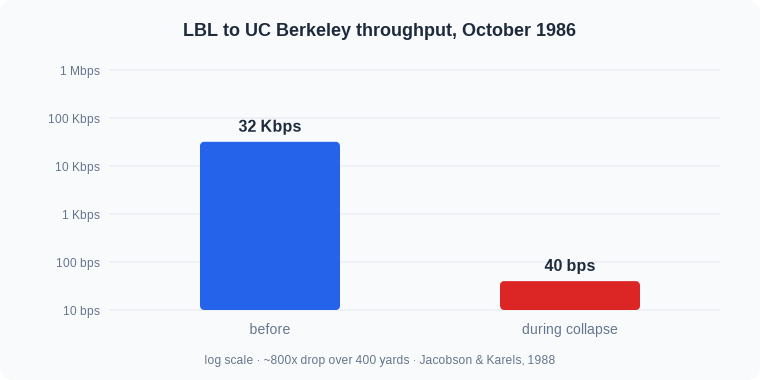
In October of ‘86, the Internet had the first of what became a series of ‘congestion collapses’. During this period, the data throughput from LBL to UC Berkeley (sites separated by 400 yards and two IMP hops) dropped from 32 Kbps to 40 bps. — Jacobson & Karels, Congestion Avoidance and Control
Jacobson calls it a “factor-of-thousand drop,” between two sites you could walk between (an IMP was one of the ARPANET’s packet switches, so two hops meant two of them). (You’ll also see the collapse quoted as 56 kbps to 320 bps. That figure comes from ESnet’s 2018 retrospective . I’m using the numbers from the paper.) The wires were fine. The failure was in the logic and the model it was intended to live in. Each sender’s TCP followed its own rules, and when Jacobson asked whether 4.3BSD TCP was misbehaving or could be tuned to do better, his answer to both was “yes.” Generally, at the time, the expectation was to reliably transmit packets. You can assume that when a packet was not acknowledged, the correct next step was to retransmit. This logic did not take into consideration the feedback the network state was communicating through failed acknowledgments and dropped packets.
John Nagle described “congestion collapse” in RFC 896 in January 1984, after pushing his own network into it on purpose. Congestion occurs as round-trip times climb faster than hosts can measure them, retransmit timers fire, and hosts “begin to introduce more and more copies of the same datagrams into the net.” Buffers fill on hosts, packets get dropped, and “as every packet is transmitted several times, throughput is reduced to a small fraction of normal.” Nagle also notes the condition is stable—the network does not recover on its own.
Flow control vs. congestion control #
It helps to separate two problems that look similar.
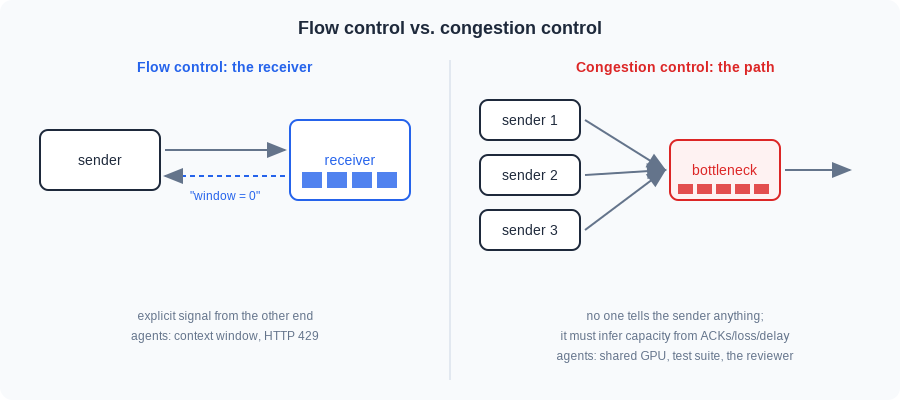
- Flow control is about the receiver. The receiving end says “my buffer is full, slow down.” It is explicit and local, and TCP has had it from the start as outlined in RFC 793 . The receiver returns a “window” with every ACK.
- Congestion control is about the path. Nobody tells the sender anything. It has to infer the spare capacity of a shared bottleneck it cannot see.
Conservation of packets #
AIMD, slow start and the sawtooth all follow from one principle that comes first in the paper.
A new packet isn’t put into the network until an old packet leaves.
Jacobson calls a connection in this state “in equilibrium” and argues that a system that conserves packets is stable under congestion. Then he notes that there are only three ways for packet conservation to fail:
- The connection doesn’t get to equilibrium
- A sender injects a new packet before an old packet has exited
- The equilibrium can’t be reached because of resource limits along the path.
All seven algorithms the paper adds to 4.3BSD TCP (RTT variance estimation, exponential retransmit backoff, slow start, a better ack policy, dynamic window sizing, Karn’s clamped backoff, fast retransmit) fix one of those three failures. This is the part I find most useful, because each of the three has an equivalent in modern system design.
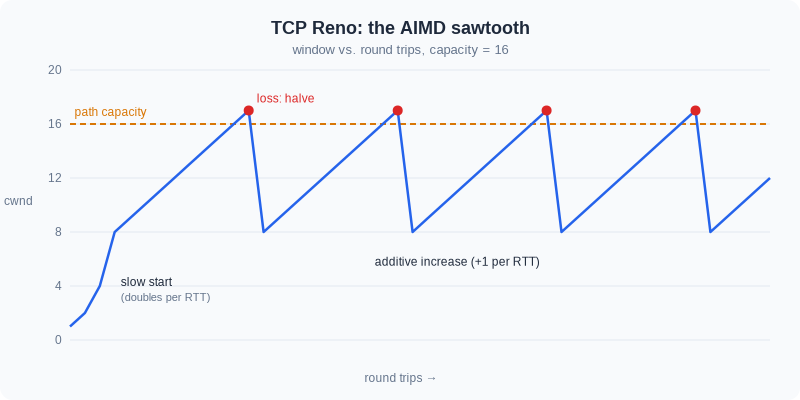
1. Not reaching equilibrium → cold-start blasting. Jacobson’s Figure 1 shows a sender that “has shipped a window’s worth of packets, back-to-back” before receiving a single ACK. Slow start adds one segment to the window per ACK, which doubles the window every round trip . It is “slow” only compared to sending the whole window at once, so the sender finds the ceiling instead of hitting it all at once. We just saw the same failure mode during recovery in Microsoft’s November 2026 Microsoft 365 post-incident report : restarted gateway servers were immediately re-overwhelmed by queued traffic on return to service, prompting Microsoft to add “gradual traffic ramp-up and admission control when servers rejoin.”
2. Injecting before something exits → spawning work before the last piece is acknowledged. In TCP the ACK is the clock. New packets go out because old ones were acknowledged, so the sender runs at the pace of the bottleneck automatically. Jacobson calls this “self-clocking”: “If packets after the first burst are sent only in response to an ack, the sender’s packet spacing will exactly match the packet time on the slowest link in the path.”
3. Resource limits on the path → the shared bottleneck. The fix is to measure the bottleneck and size the window to it. In modern agent systems, that bottleneck is rarely raw network bandwidth—it is API rate limits (tokens or requests per minute), local GPU concurrency, or human reviewer queues.
What counts as an ACK? #
I think this is where the determinism question gets decided and where we can see the concept translate to newer technology, like “agents”. TCP works because the ACK comes from the other end, not from the sender judging itself, and because it is cheap and unambiguous. A packet was either delivered or it wasn’t.
The usual agent equivalent of an ACK is the model saying “Done! All tests pass.” That is the sender acknowledging its own packets, and in my experience it’s the largest source of non-determinism in agent loops. The research points the same way. Huang et al. (2023) found that LLMs “struggle to self-correct their responses without external feedback, and at times, their performance even degrades after self-correction,” while CRITIC (Gou et al., 2023) gets consistent gains by checking outputs against tools such as search and a code interpreter, and stresses “the crucial importance of external feedback.”
So an agent ACK should come from outside the model. We have seen harness or loop engineers move to a typecheck or test suite passing on the new snapshot or a diff that actually changed. Loss is the inverse, and it includes the quiet cases: a gate failing, a worker returning nothing (an empty result is not a success), or a “fix” turn that leaves the code unchanged.
Carrying the rest of the paper over #
Once there is a real ACK, the rest of TCP’s toolbox applies almost directly:
- Conservation. Nothing new gets dispatched until something in flight has been acknowledged. The next unit of work starts because the last one verifiably finished, not because a timer fired or the model felt done.
- AIMD, the way Reno does it. Grow the amount of work in flight slowly on success and cut it sharply on failure. This isn’t arbitrary: Chiu & Jain (1989) showed that additive increase with multiplicative decrease “satisfies the sufficient conditions for convergence to an efficient and fair state regardless of the starting state of the network,” from nothing more than a one-bit overloaded/underloaded signal. That also means several agents sharing one GPU or one reviewer can converge to a fair share without coordinating. Reno adds a distinction worth keeping. If packets are lost but later ones are still being acknowledged, the path is congested but working, so Reno halves the window once per window of data (RFC 5681 fast recovery). If nothing comes back and the retransmit timer fires, it drops all the way to one and slow-starts again. Tahoe, the 1988 version, did the full reset for every loss. For agents, that’s the difference between “two of my five workers hit a rate limit while the others finished” and “nothing has finished at all.”
- Karn’s rule: don’t learn from retries. RFC 6298 says RTT samples “MUST NOT be made using segments that were retransmitted,” because you can’t tell which copy the reply was for. Similarly, a task that passed on its third attempt tells you little about how long that kind of work should take.
- Exponential backoff, then stop. When the signal goes quiet, wait longer each time, and when the backoff runs out, report the work as incomplete instead of continuing.
The first principle #
Strip away the networking and what’s left is fairly small:
- Don’t put new work in until old work has verifiably left.
- Let something other than the worker decide whether the work left.
- Back off multiplicatively, recover additively, and stop with an honest
incompletewhen backoff runs out. - Watch the queue, not just the failures.
TCP didn’t get a central authority to slow everyone down. It got a reliable signal and a simple, deterministic response to it, and that was enough to make a network of misbehaving senders stable for nearly forty years.
Sources #
The collapse
- Jacobson & Karels, Congestion Avoidance and Control, revised version of the SIGCOMM ‘88 paper (doi:10.1145/52325.52356 ): ee.lbl.gov/papers/congavoid.pdf
- Nagle, RFC 896: Congestion Control in IP/TCP Internetworks (January 1984): datatracker.ietf.org/doc/html/rfc896
- ESnet, Unjamming the Information Superhighway and saving the Internet (2018), the source of the 56 kbps / 320 bps figures: es.net/about/esnet-history/unjamming-the-information-superhighway-and-saving-the-internet
TCP mechanics
- RFC 793: Transmission Control Protocol (1981): datatracker.ietf.org/doc/html/rfc793
- RFC 6298: Computing TCP’s Retransmission Timer (2011), incl. Karn’s algorithm: datatracker.ietf.org/doc/html/rfc6298
- Karn & Partridge, Improving Round-Trip Time Estimates in Reliable Transport Protocols, SIGCOMM ‘87: doi:10.1145/55483.55484
- Dordal, An Introduction to Computer Networks, ch. 19 “TCP Reno and Congestion Management”: intronetworks.cs.luc.edu/current/uhtml/reno.html
- Chiu & Jain, Analysis of the Increase and Decrease Algorithms for Congestion Avoidance in Computer Networks, Computer Networks and ISDN Systems 17 (1989): doi:10.1016/0169-7552(89)90019-6 , author copy
- Balakrishnan, Padmanabhan, Seshan & Katz, A Comparison of Mechanisms for Improving TCP Performance over Wireless Links, IEEE/ACM ToN (1997): doi:10.1109/90.650137
Bufferbloat & model-based control
- Gettys & Nichols, Bufferbloat: Dark Buffers in the Internet, ACM Queue 9(11) (2011): queue.acm.org/detail.cfm?id=2071893
- Cardwell, Cheng, Gunn, Hassas Yeganeh & Jacobson, BBR: Congestion-Based Congestion Control, ACM Queue 14(5) (2016): queue.acm.org/detail.cfm?id=3022184
LLM feedback
- Huang et al., Large Language Models Cannot Self-Correct Reasoning Yet (2023): arxiv.org/abs/2310.01798
- Gou et al., CRITIC: Large Language Models Can Self-Correct with Tool-Interactive Critiquing (2023): arxiv.org/abs/2305.11738
Further reading
- Microsoft, Post Incident Report for Microsoft 365 (EX1550543 / MO1550821) (November 20, 2026): tianyin.github.io/misc/pir_microsoft_365_11-12-2026.pdf
- RFC 5681: TCP Congestion Control: datatracker.ietf.org/doc/html/rfc5681
- Fall & Floyd, Simulation-based Comparisons of Tahoe, Reno, and SACK TCP: cs.cornell.edu/…/fall96simulationbased.pdf
- CMU 15-441 recitation, TCP Congestion Control: cs.cmu.edu/~prs/15-441-F15/lectures/rec05-congestion.pdf
- Brakmo, Analysis and Evaluation of TCP Congestion Algorithms, Netdev 2.2: netdevconf.info/2.2/papers/brakmo-tcpcongestionanalysis-talk.pdf
- Internet Congestion Control Benchmarking (arXiv:2307.10054): arxiv.org/abs/2307.10054
Harness
- pi-loop: github.com/trvon/pi-loop
Follow on Substack
New research notes, systems writing, and follow-ups are cross-posted to Substack. Subscribe to get new posts by email.